BuildFest 2: Peace Rises

Bethel, NY
September 10-14, 2025
Learn More

From September 10-14, 2025, more than 150 students and faculty members converged on the grounds of the 1969 Woodstock music festival in Bethel, New York, for BuildFest 2: Peace Rises. Over five days, participants camped, collaborated, and created on the historic site as they explored how wood building systems can advance principles of sustainability and efficiency in the built environment.

The festival challenged 10 teams from universities across the U.S. and Canada to step out of the classroom and construct interactive, large-scale wood installations using experimental fabrication methods to create unique assemblies. Sponsored by Think Wood, BuildFest provided a hands-on design-build experience that equipped both faculty and students with valuable, formative knowledge.

2025 BuildFest installations will be open to the public through the end of the year. The theme and call for proposals for next year’s BuildFest will be announced in February 2026.

Polylith
Project Leaders: Ekin Erar and Lawson Spencer | University Affiliation:Syracuse University (Erar) and Cornell University (Spencer)

News + Updates

BuildFest 2: Peace Rises

Event | BuildFest 2: Peace Rises
From Woodstock to Wood Systems: Rethinking Design, Fabrication, and Assembly at BuildFest 2
BuildFest 2: Peace Rises offered students and faculty an immersive, five-day design-build experience exploring the power of technology in changing design and construction.

From September 10-14, 2025, BuildFest 2: Peace Rises welcomed 10 teams from universities across the United States—including Princeton University, Cornell University, Carnegie Mellon University, and the University of California, Los Angeles—to create large-scale wood installations on the historic grounds of the 1969 Woodstock festival in Bethel, New York. By day, students participated in hand-craft and robotics workshops and worked together to bring their installations to life. By night, they celebrated in true Woodstock fashion with live music, yoga, football matches, and more, according to the event website.

Echoing the disruptive ethos of the site’s history, the festival encouraged teams to test new ways of working. It focused on shortening feedback loops between design and production, allowing assembly to influence the form earlier than traditional drawings would allow. Many projects confronted foundational questions about disassembly, reuse, and sequencing from the outset, treating construction as an active design tool rather than a final step. Wood was essential to this approach–its lightweight, machinable, and reversible nature supported full-scale risk-taking without the cost or inertia of steel or concrete. In this context, lumber functioned not as a symbol but as an enabler by supporting experimental workflows grounded in performance, adaptability, and shared problem-solving.

Explore the built installations below:
  • Peace Pavillion

    Project Leaders: Amanda Reis and Eduardo Aquino (AREA)

    University Affiliation: Rochester Institute of Technology Architecture and University of Manitoba

    Student Team: Ralph Gutierrez, Noah Baldon, Maddy Bortle, Anna-Leigha Clarke, Ryan Denberg, Sydney Fox, Gabriela Hernandez, Gil Merod, Mackendra Nobes, Julia Resnick, Youngjin Yi, Michael Buffalin, Jim Heaney, and Chris Vorndran.

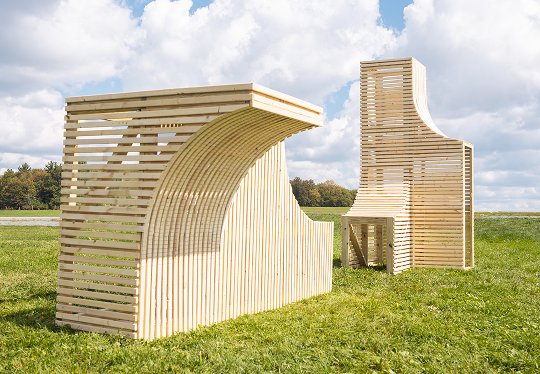
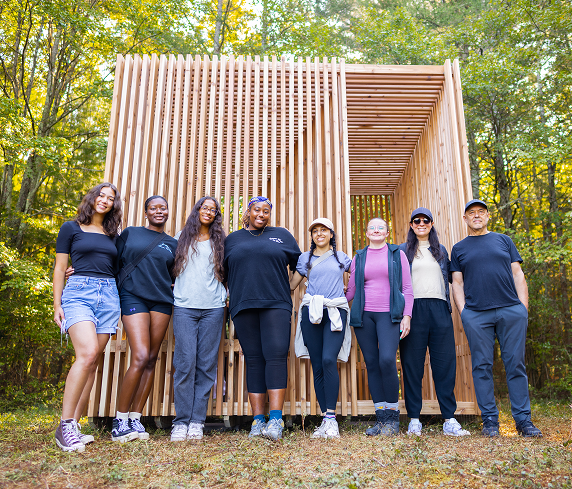
    From the Project Team: The Peace Pavilion celebrates the spirit of the Woodstock Festival by reimagining our relationship with the concept of “peace.” Based on the Yin and Yang symbol—interconnected opposites forming a harmonious whole—the pavilion comprises two identical spaces divided by a central timber screen, laser-engraved with poetry, quotes, and lyrics from Woodstock, and thus evoking a layered, meditative experience that honors both individuality and togetherness. As visitors enter from either side, they create a quiet moment of reflection and reciprocal awareness. The structure was prefabricated at Rochester Institute of Technology’s Student Hall for Exploration and Development, then shipped and assembled at Bethel Woods using uncut linear lumber in conjunction with a digital fabrication process to produce virtually zero waste.

    Peace Pavillion
    Photo Credit: Breyden Anderson
  • Nesthavnette

    Project Leader: Dr. Arash Adel (Adel Research Group)

    University Affiliation: Princeton University

    Student Team: Salma Mozaffari, Daniel Ruan, Jutang Gao, Namdev Talluru, Roman Ibrahimov, Yiqing Wang, Michael Papagni, Rida Sajjad, Karen Arroyo, Anthony Sorrentino

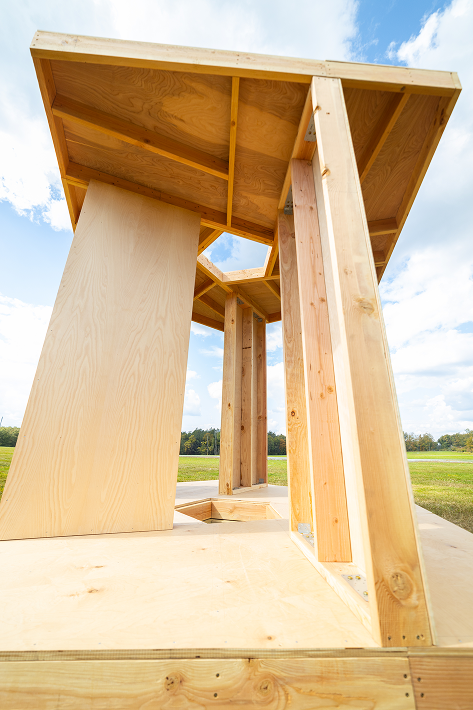
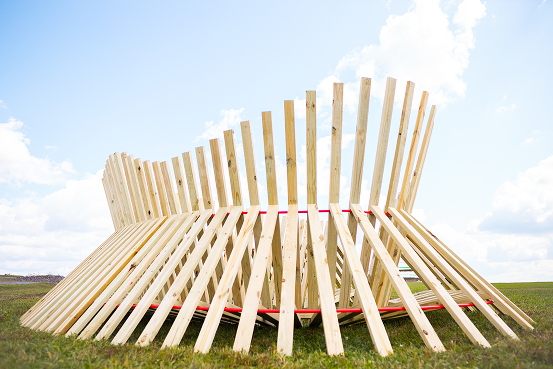
    From the Project Team: Nesthavnette merges human creativity with robotic fabrication to create a hexagonal contemplative retreat. Assembled from timber pieces using human-robot collaborative construction (HRCC) techniques, this enclosed, cabin-like installation offers a space for reflection, stillness, and one-on-one dialogue with the landscape. Nesthavnette evokes a sense of abstracted nature—where form, material, and light reinterpret the forest’s presence, guiding visitors into a slowed rhythm of observation and listening. It stands as a meditative landmark shaped by art, technology, and ecology, continuing Woodstock’s legacy of creativity and connection.

    Nesthavnette
    Photo Credit: Breyden Anderson
  • Trillium

    Project Leaders: Chris Humphrey and Andrew Colopy

    University Affiliation: Rice University

    Student Team: Alex Pina, Manuella Gbossou, Jim (Jingping) Wu, Shaelyn Parker, Fatima Castro, Grace Andrews, Benjamin Rao, and Braden Birko

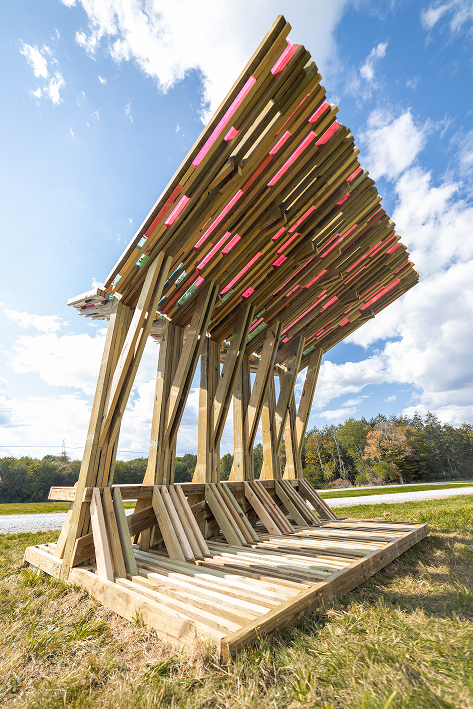
    From the Project Team: Trillium takes formal and conceptual inspiration from the native Trillium flower, long associated with themes of renewal and transformation. Echoing the flower’s morphology, the pavilion unfolds as a translucent red petal that invites visitors to engage with light, material, and memory—evoking both the ephemeral beauty of nature and the countercultural spirit of Woodstock’s “flower power.” At the core of the project is an investigation of rebirth—not only as metaphor, but as material methodology. Continuing a line of research into computational design of waste-based material assemblies, the pavilion utilizes reclaimed wood and post-industrial plastic. Its structural system employs traditional timber joinery, reinterpreted through modern fabrication to accommodate the irregularities of salvaged stock. Recycled plastic panels are then milled to fit within the grooves of the reclaimed wood siding, forming a translucent envelope that captures and refracts sunlight. The result is a luminous, meditative space—a material expression of rising peace rooted in cycles of reuse and renewal.

    Trillium
    Photo Credit: Breyden Anderson
  • Polylith

    Project Leaders: Ekin Erar and Lawson Spencer

    University Affiliation: Syracuse University (Erar) and Cornell University (Spencer)

    Student Team: Varun Gandhi, Jacob Gibbons, Seh Eun Emily Hong, Austin Johnson, Torben Karl, Yuji Kitamura, Brooke Kenworthy, Amina Lahham, Bo Li, Edozie Onumonu, Kobe Phillips, Helen Bennett, Katharine Marr, Saffiyah Subhan-Khan, and Clark Dong

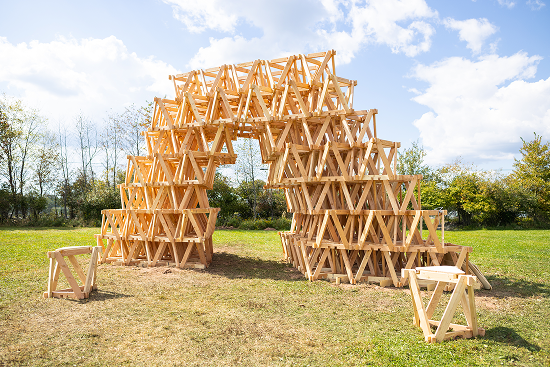
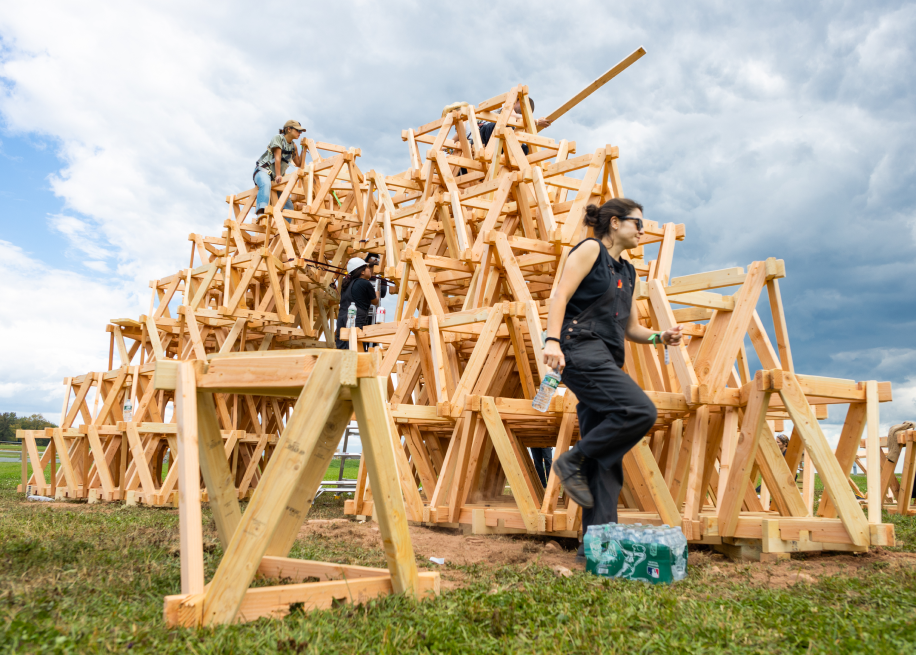
    From the Project Team: Polylith reimagines construction as a collective, ritualistic act rather than a finished object. Drawing inspiration from Bill Hanley’s sound scaffolds at Woodstock in 1969, the project combines the logic of scaffolding with a modular, robotically fabricated timber system that is lightweight, mono-material, and easily assembled without hardware or glue. Each cubic module, milled with intricate joints by a six-axis robotic arm, can be carried by one or two people and stacked to create a structure that is both a shading pavilion and stage. Designed for adaptability and circularity, Polylith prioritizes shared authorship, enabling ongoing reconfiguration and public interaction. Ultimately, the pavilion serves as a testbed for new digital fabrication workflows while also advancing a sustainable, inclusive model for building that echoes the communal spirit of Woodstock through collective construction and play.

    Polylith
    Photo Credit: Breyden Anderson
  • Ashes to Assembly

    Project Leaders: Kutan Ayata and Cameron Kursel

    University Affiliation: University of California, Los Angeles

    Student Team: Amber Grovet, Alexandra Ferreira, Nathan Logan, and Hunter Blackwell

    From the Project Team: The project begins with the haunting image left in the wake of the 2025 California wildfires, where fields of solitary hearths stood amid the rubble as monuments to resilience—remnants of shared domestic life that endured even as homes disappeared. Here, Ashes to Assembly reimagines the hearth as a freely scalable and reconfigurable assemblage of timber monoliths that draw from vernacular hearth traditions across cultures: the nested seating of the German Kachelofen, the radial openness of the Japanese Irori, the resting surface of the Russian Pechka, and the ceremonial fire practices of the Lenape peoples. Referencing a form both ancient and enduring, the project becomes a space for reflection, conversation, rest, and repair. It acknowledges fire’s dual nature—destructive and vital, isolating and communal—and offers a place to reckon with the climate crisis through the act of assembly. Rather than a retreat, Ashes to Assembly offers a new commons: a hearth to warm the body, focus the mind, and convene those willing to imagine—together—a way forward.

    Ashes to Assembly
    Photo Credit: Breyden Anderson
  • Flip!

    Project Leaders: Stephanie Sang Delgado, Galo Canizares, and Fabio Castellanos

    University Affiliation: Kean University (Sang Delgado and Castellanos) and University of Kentucky (Canizares)

    Student Team: Alexa Acuna, Kamila Diaz Calderon, Vanessa Vallejo, Lauryn Repollet, Rimervi Mendez Vasquez, Thomas Hoy, and Tiferet Fischman

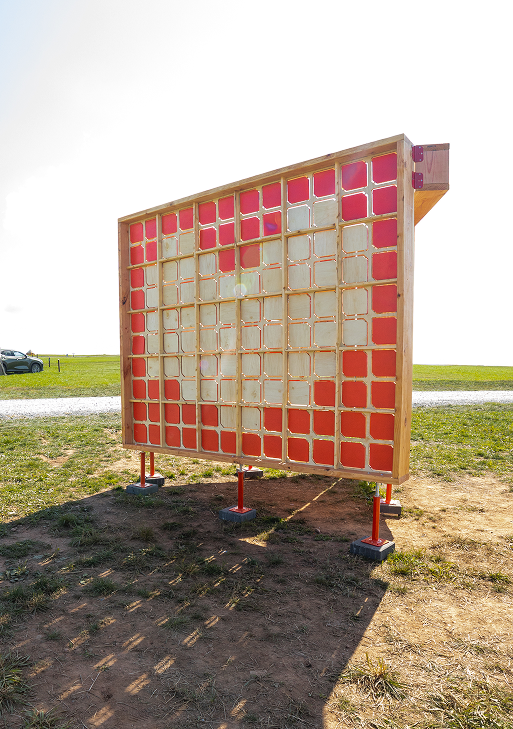
    From the Project Team: Flip! is an interactive pavilion that reimagines architecture as a playful, human-scale interface. Designed as a large-scale split-flap screen, each self-supporting wall features movable tiles: one side mirrored with outdoor-grade vinyl, the other brightly colored. Visitors are invited to play, rest, and interact—flipping tiles to create patterns, play games, and leave messages. The shifting surfaces create a dynamic visual experience visible from both sides, sparking spontaneous interaction. The walls form an intimate outdoor room, offering shade and a place to unwind.

    Flip!
    Photo Credit: Breyden Anderson
  • Stacked & Strapped

    Project Leader: Benjamin Vanmuysen

    University Affiliation: Rensselaer Polytechnic Institute 

    Student Team: Allison Motler, Nihar Menon, Jack Zhang, Allyson Devine, and Abigail Lagana

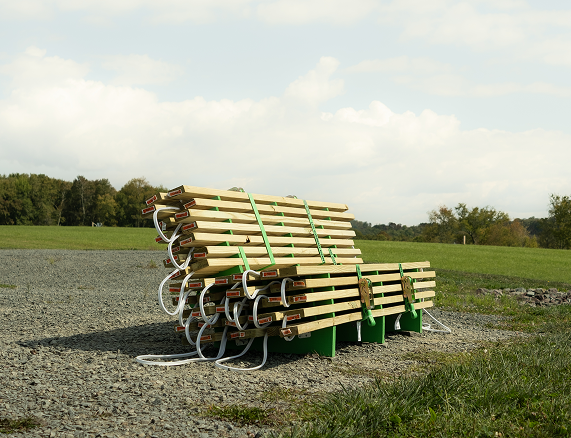
    From the Project Team: Stacked and Strapped is embodied as a large bench, constructed solely from uncut dimensional lumber. Two stacks of 2x4s are strapped together to encourage visitors to recline, gather, and engage with the installation. While the bench celebrates the banal during the day, it transforms at dusk into a quiet lantern—glowing like a firefly from within. The proposal uses forty-four 2×4 studs, assembled without any fasteners. The 8-foot studs are then separated by ½-inch spacers and secured with four ratchet straps. Battery-powered LED strips run between the members, illuminating the structure at night. Because no fasteners are used, all lumber can be reused after the festival.

    Stacked & Strapped
    Photo Credit: Jack Zhang
  • Ignis Mentis

    Project Leaders: Kim Hagan and Michelle Pannone

    University Affiliation: Marywood University 

    Student Team: Angelina F. Cardin, Jocelyn N. Dames, Cesia De la Paz Ojito, Emily A. Festa, Colette M. Fetter, Samantha C. Kraft, Derrick Ricci-Riner, Rweza R. Rugabandana, Miranda L. Taveras, Brianna J. Conniff, Nolla Morawiec, Barbale Tsulaia, Theresa Le, and Yocilia Leon

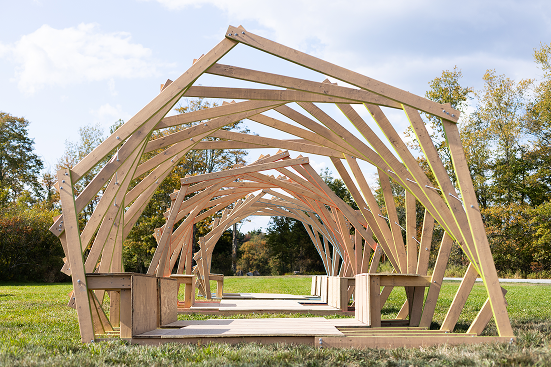
    From the Project Team: Ignis Mentis manifests as a multi-sequence path that guides users through an immersive spiraling wooden tunnel. Inspired by traditional stud-frame construction, the design rotates and reconfigures familiar elements to transform them into something surprising. The shifting geometry of the installation highlights the contrast between conventional and experimental forms/techniques, harnessing the mundane to create something new.

    Ignis Mentis
    Photo Credit: Breyden Anderson
  • Flux

    Project Leaders: Kelly Wilton, Fabiano Sarra, and Joseph Allgeier

    University Affiliation: Rochester Institute of Technology School of Design

    Student Team: Bennett Hu, Myles Vasta, Courtney Lougheed, Audrey Martignetti, Chloe Cheatle, Justine Kim, Ethan Anthony, Aiden Spicer, Isabelle Chav, and Edward Elliott

    From the Project Team: Flux was designed as a gathering place for people, the flames of creativity that, when in collaboration, can ignite a greater force for good. Echoing the form of the campfire, its use of 70 modules embodies collaboration in its construction and interaction.

    Flux
    Photo Credit: Breyden Anderson
Back to top

Get wood trends, project profiles, and design resources in your inbox.

Sign Up!