Civic Community
Mass Timber Brings Civic Ambition to a Public Utility
When one of Southern California’s largest sanitation utilities set out to consolidate outdated offices into a new headquarters, mass timber wasn’t even on the table. But a rigorous analysis of construction efficiency, energy performance, and lifecycle value revealed a different calculus: mass timber wasn’t a premium choice, it was a cost-competitive investment that made sense. The result is more than a cost-effective headquarters—it is a civic statement about accountability, sustainability, and the evolving role of public infrastructure.
Orange County Sanitation District Headquarters
Mass Timber as a Cost-Effective Choice for Public Infrastructure
At the outset, choosing mass timber for its new headquarters wasn’t a foregone conclusion for the Orange County Sanitation District. Serving 2.6 million residents in Southern California, the agency must demonstrate fiscal prudence and answer to public ratepayers. So when architecture firm HDR suggested the agency consider mass timber, their client was apprehensive.
“Convincing them that mass timber was a viable option took some time. As a public utility, it was essential that it come in on budget and not exceed the cost of a standard office building. They were a little petrified,” says Kate Diamond, principal at HDR. “We essentially said; ‘If we can prove that a true high-performance, sustainable building won’t cost you more, would you let us pursue that approach for this project?’ And what we discovered was just how cutting edge they already were in their water treatment operations—they had been breaking new ground for decades and this approach really aligned nicely with their culture of innovation.”
Orange County Sanitation District Headquarters
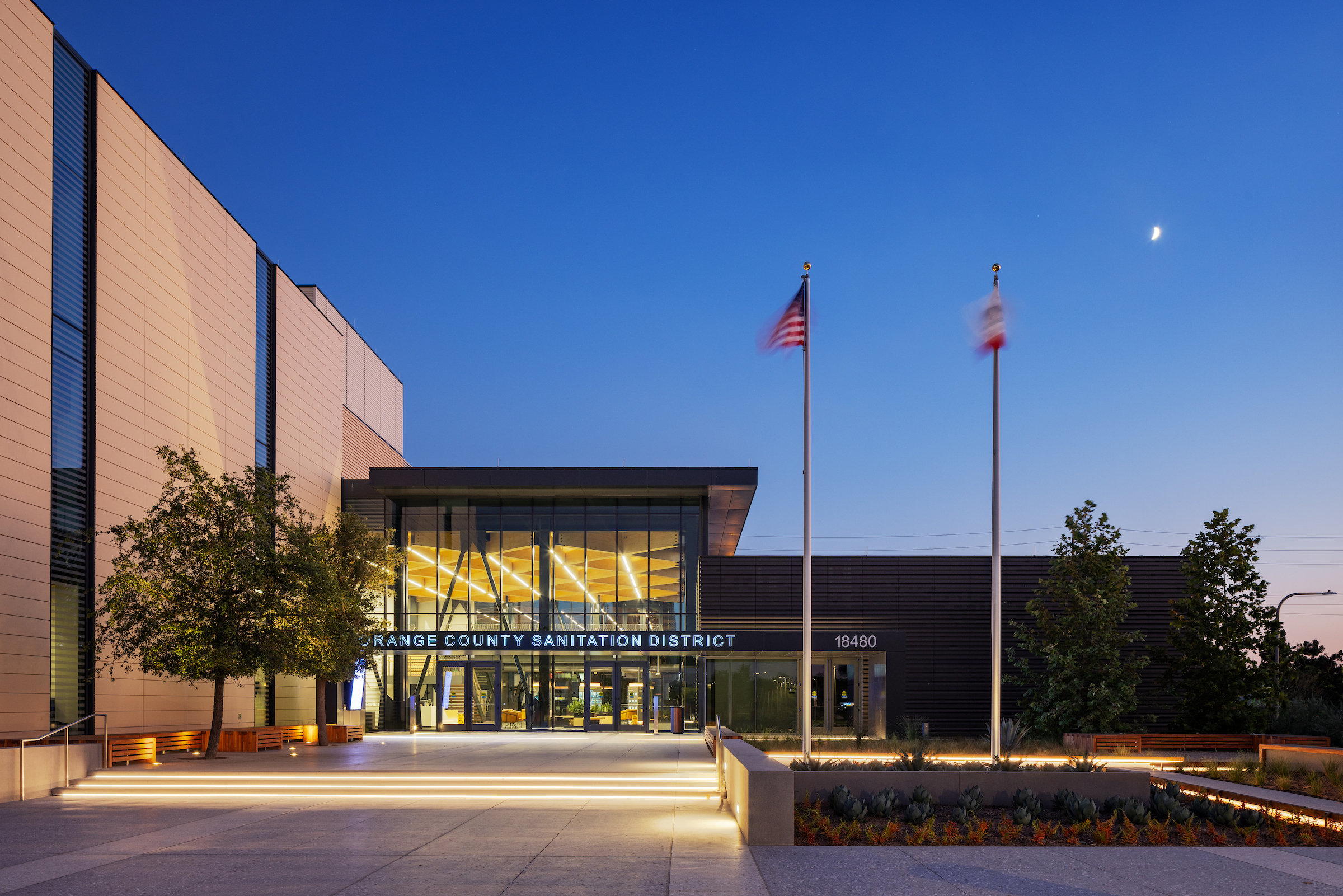
Orange County Sanitation District Headquarters
To truly test if it was feasible, the design team developed a steel-and-concrete scheme in parallel to a mass timber proposal and carried both well into design. The systems were evaluated side by side through detailed cost modeling and life-cycle analysis. “They needed to be able to say, ‘We made the right decision. We really did our homework,’” says Tom Knittel, principal at HDR. The analysis showed that a hybrid system—mass timber gravity framing paired with a steel lateral structure—could meet the budget while cutting embodied carbon, boosting workplace wellness, and meeting sustainability goals. By the time the project broke ground, the client was all in on mass timber, reflects Knittel. “They not only saw its practical benefits, but how the building’s architectural expression could play a vital role in their civic mission.” Previously, the District operated out of a patchwork of facilities with little public profile. This new all-in-one headquarters gives the agency a clear and visible identity, and a tangible point of engagement with the public it serves, Knittel added.
And the response has been outstandingly positive. “We’ve had an open house where we’ve had over 1,300 guests come through,” says Jennifer Cabral, Director of Communications for the Orange County Sanitation District. “And by far the response is: ‘Wow. This does not look like a wastewater treatment facility and/or even a government building.”
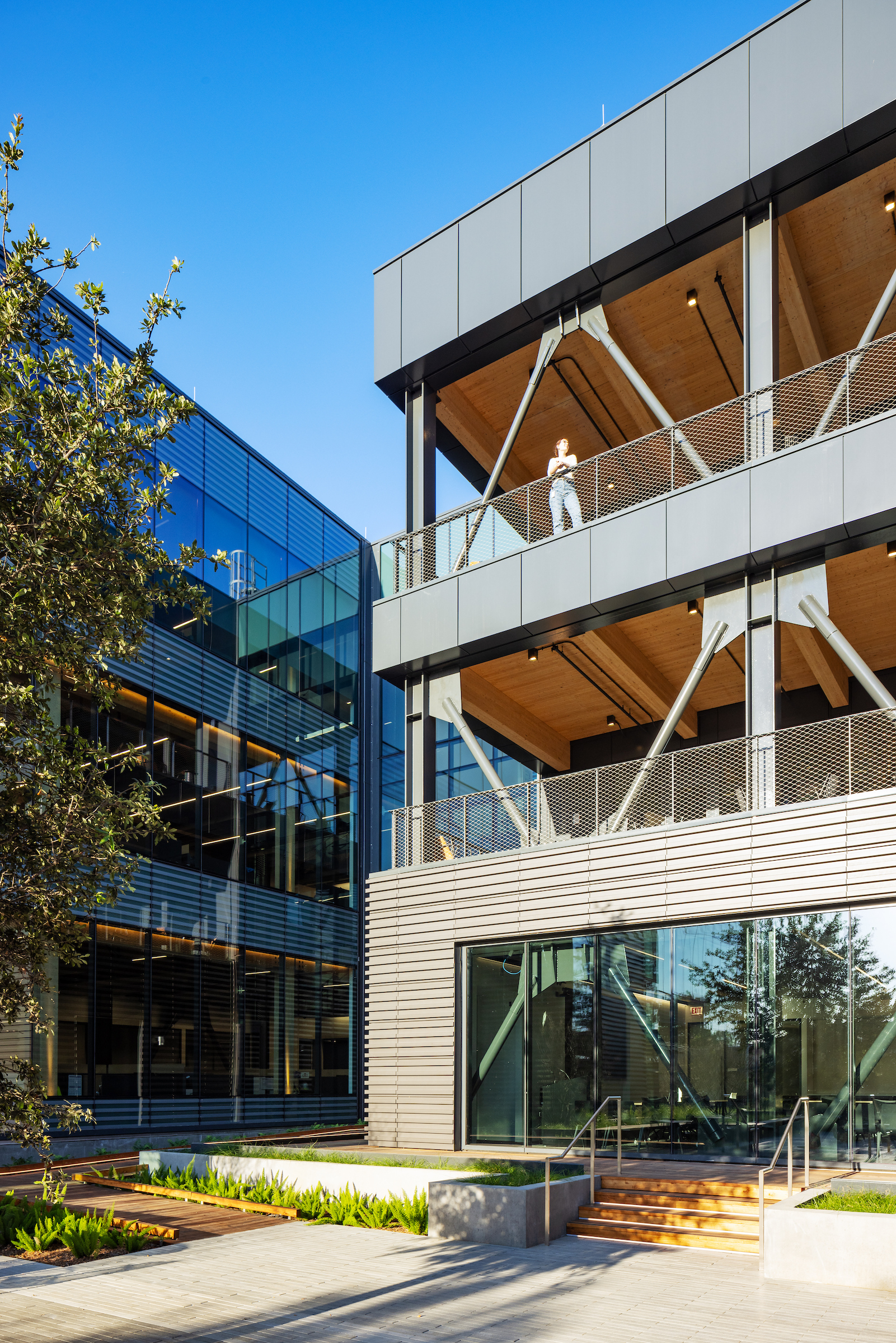
Orange County Sanitation District Headquarters
Making Mass Timber Work: Engineering, Energy, and User Experience
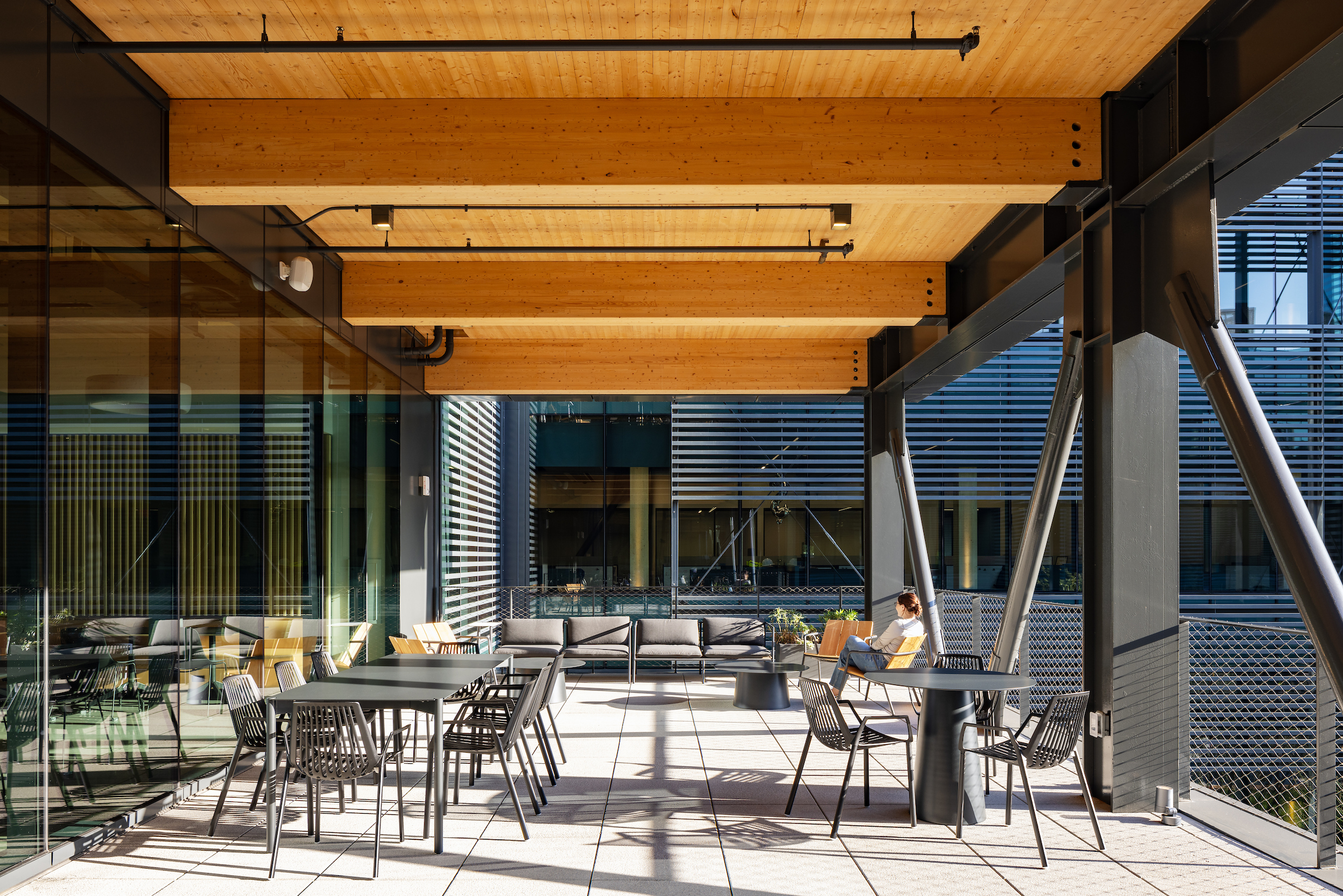
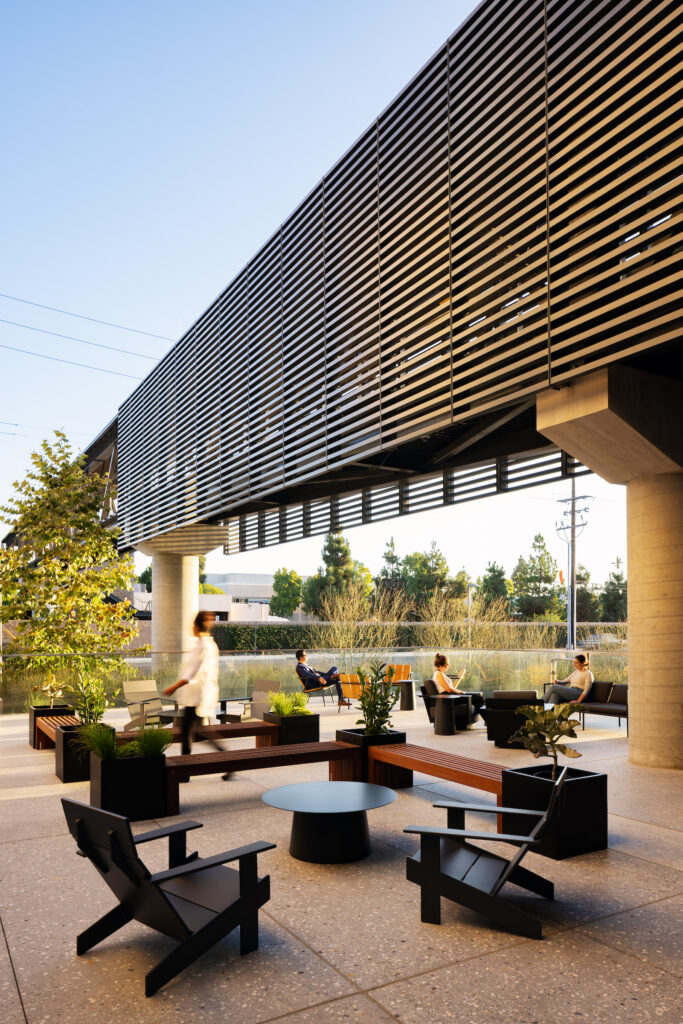
The resulting design replaces 13 different trailers and aging office buildings with a two-story, 100,000-square-foot headquarters organized into two parallel office wings flanking a landscaped courtyard. Along with its civic presence, it’s a configuration that draws daylight into both sides of the building and affords a shared outdoor space for staff.
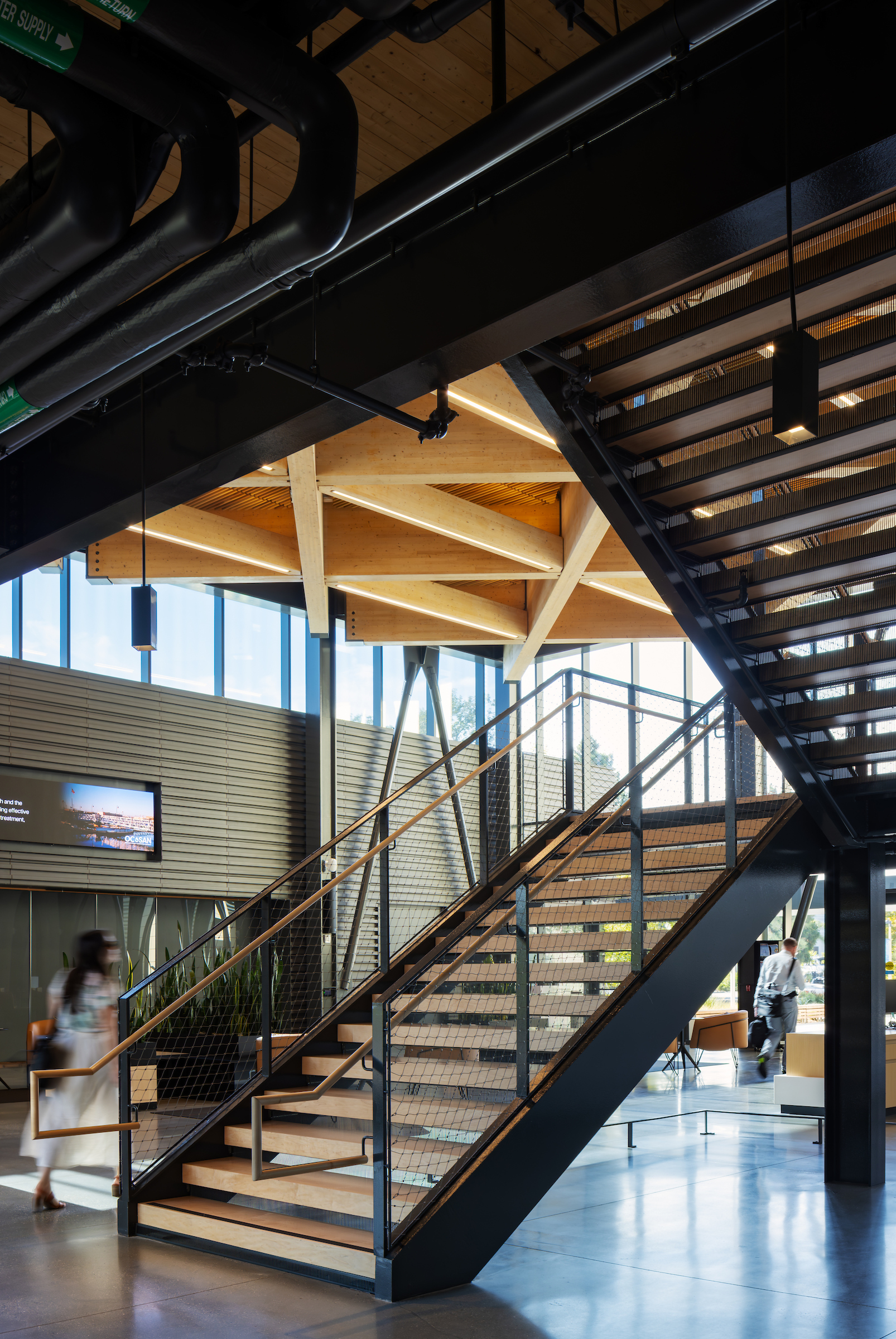
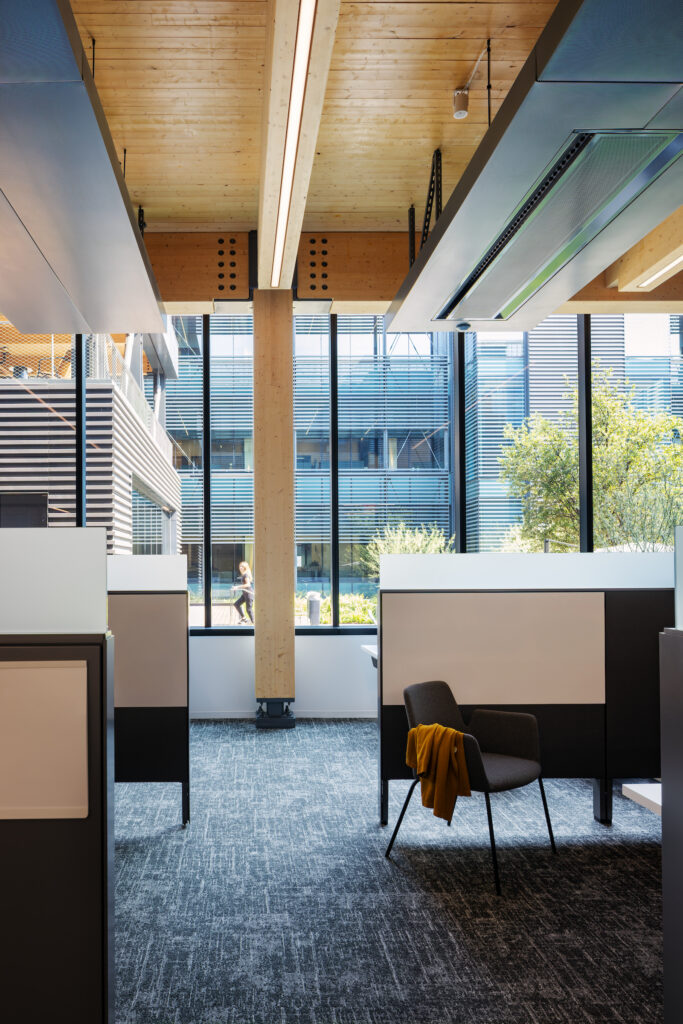
The hybrid structure employs glulam columns and beams that support cross-laminated timber (CLT) floor panels across the office wings, establishing a regular structural grid that supports efficiency and repetition, accelerates installation, and improves cost predictability. “In this seismic region, that combination made a lot of sense, and helped convince the client that mass timber was a good choice,” says Vartan Chilingaryan, structural engineer at HDR.
“Every site has unique challenges, and this one included poor soils and liquefaction concerns. Because mass timber is significantly lighter than conventional construction, the building required smaller foundations, which reduced both structural demands and costs,” explains Chilingaryan. The lighter structure also offers advantages in earthquake-prone Southern California. “Seismic forces are tied directly to mass—the lighter the building, the less excitation it experiences. That efficiency allowed us to mitigate seismic forces while helping the project stay on budget,” Chilingaryan says.
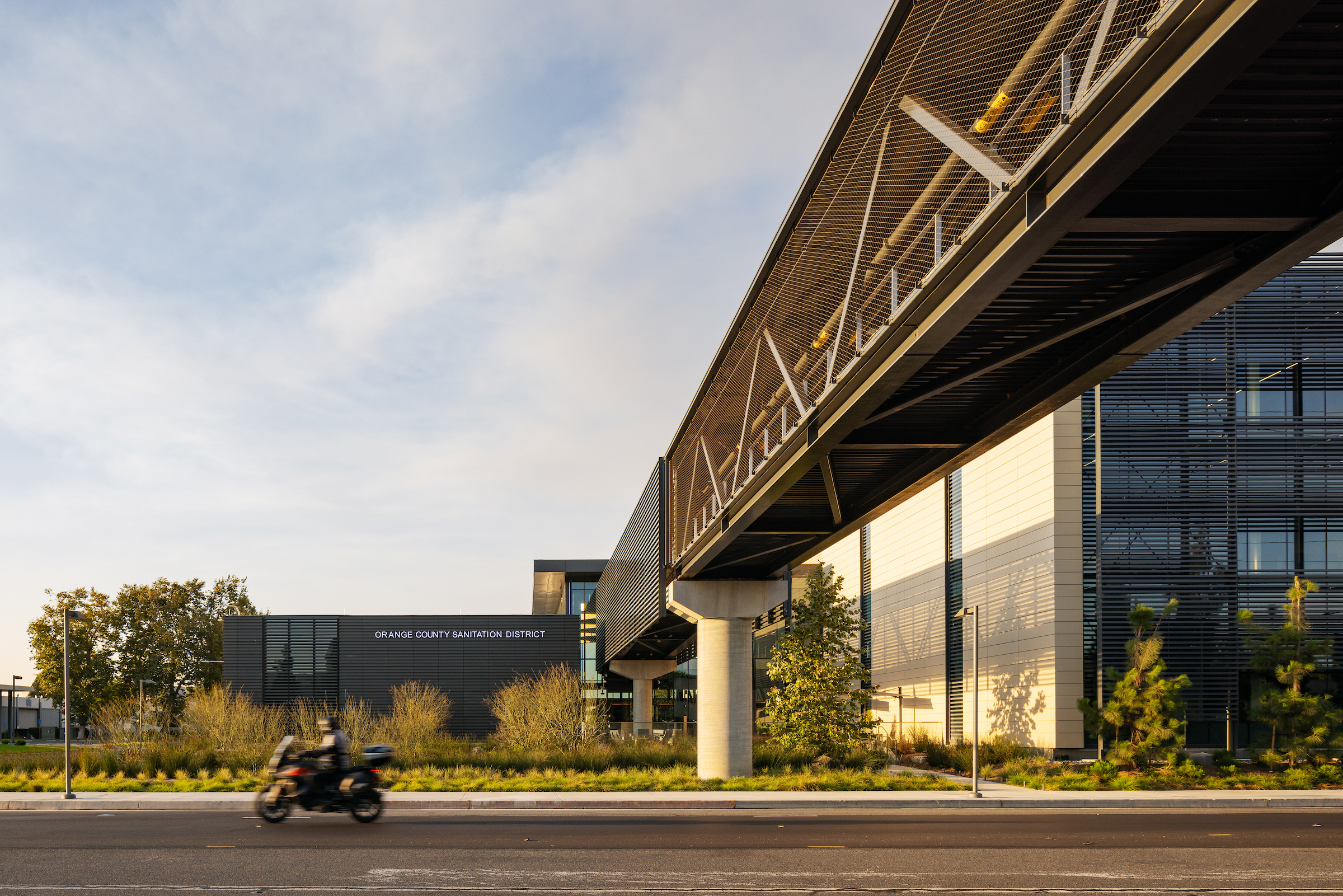
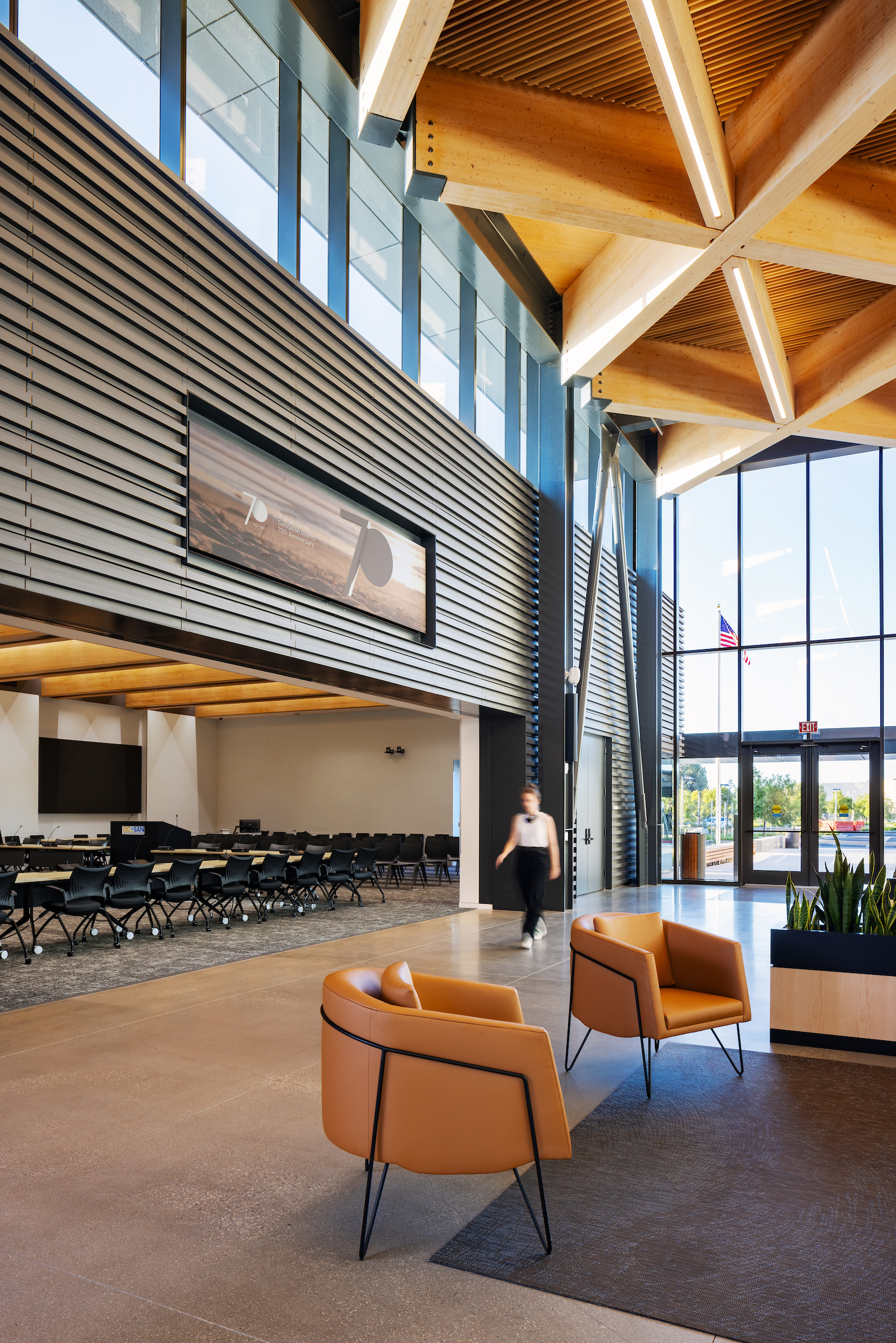
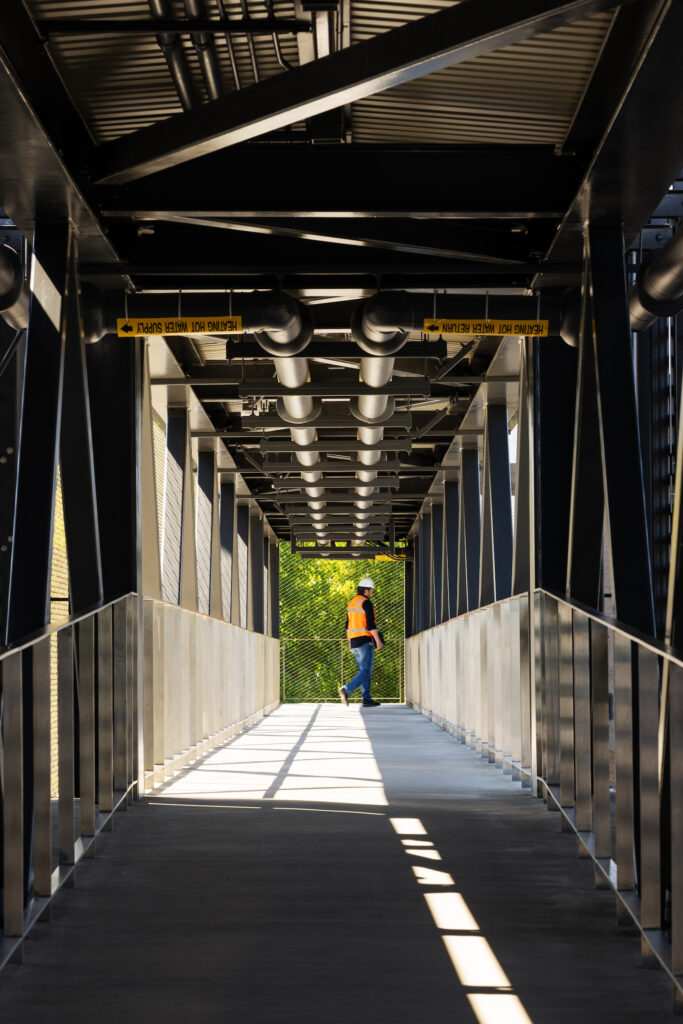
A double-height lobby marks the primary entry, with the board room and community meeting spaces positioned prominently at the front. “We wanted the public functions to be visible and accessible, not tucked away,” Diamond says. A pedestrian skybridge connects the offices directly to wastewater operations, allowing staff to move efficiently between facilities without leaving the campus.
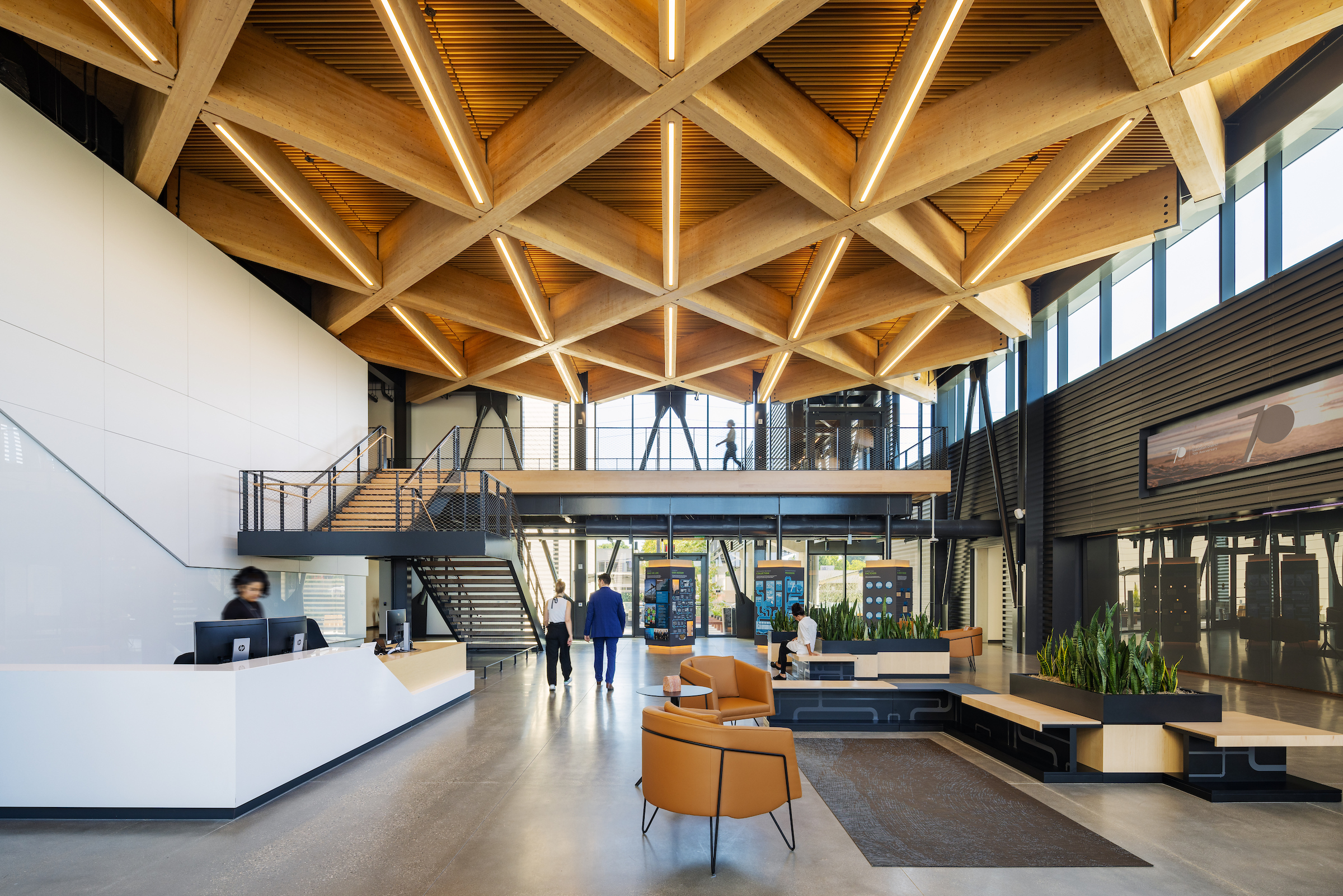
Orange County Sanitation District Headquarters
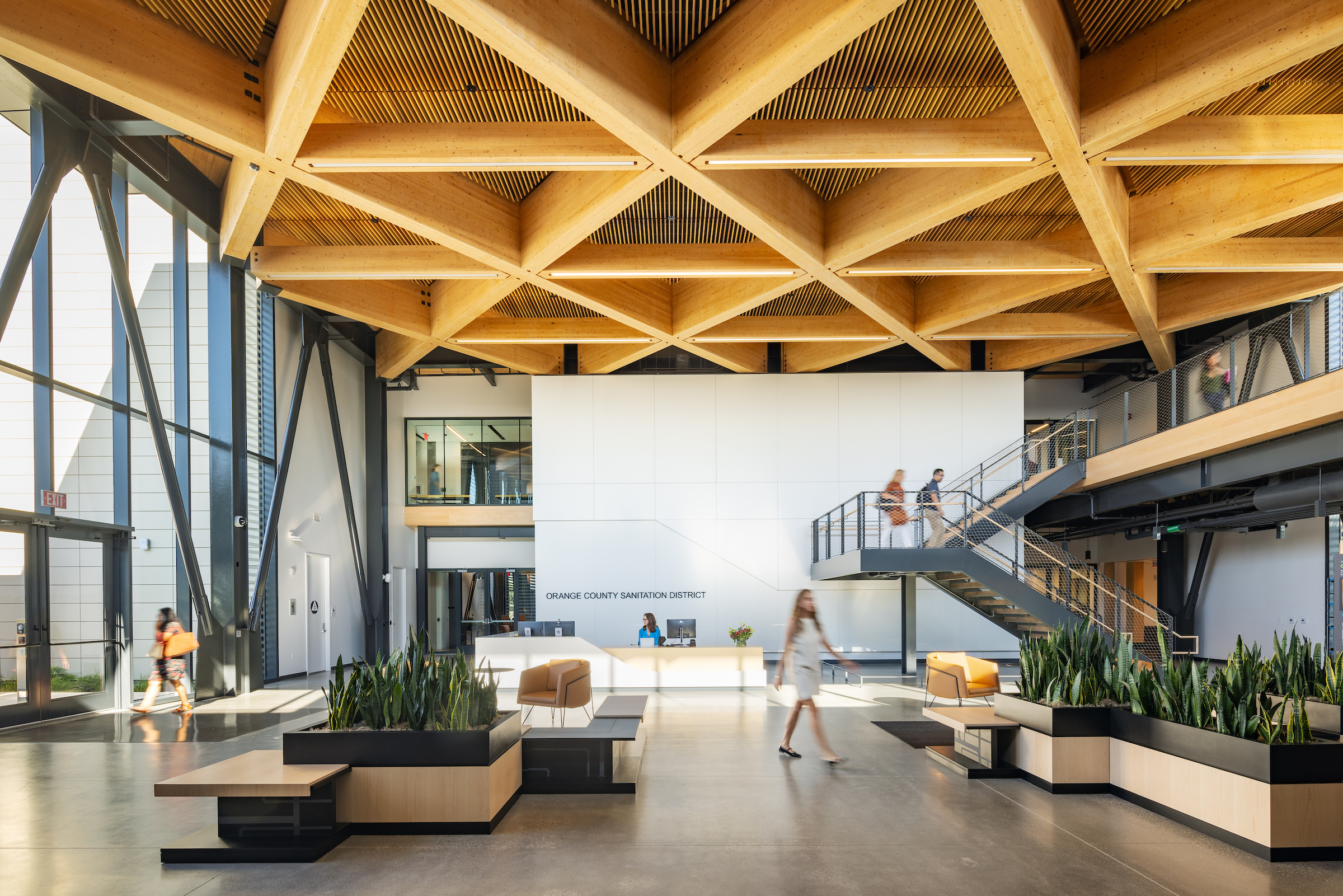
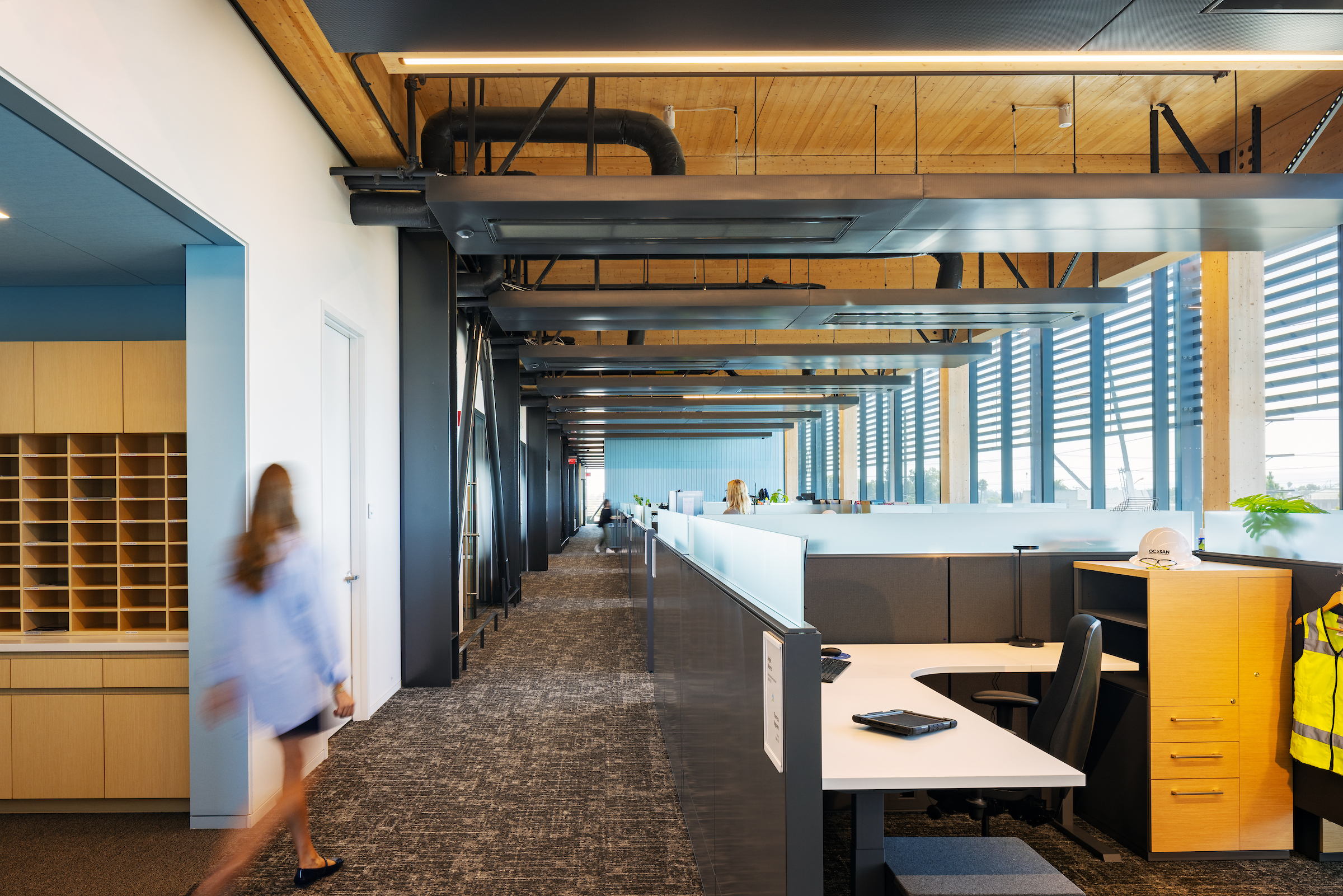
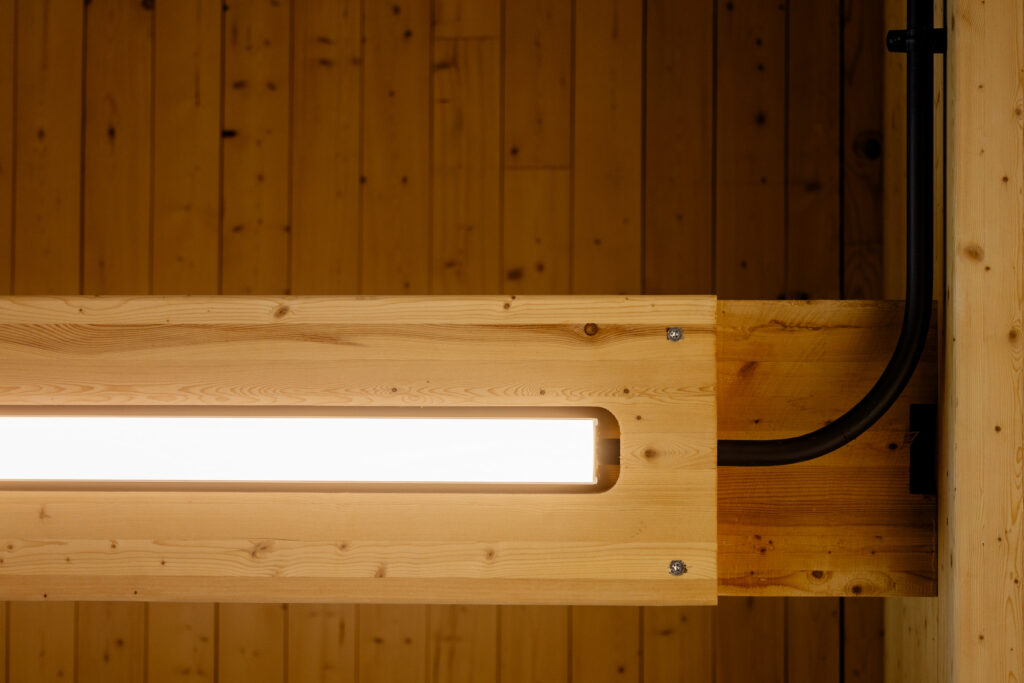
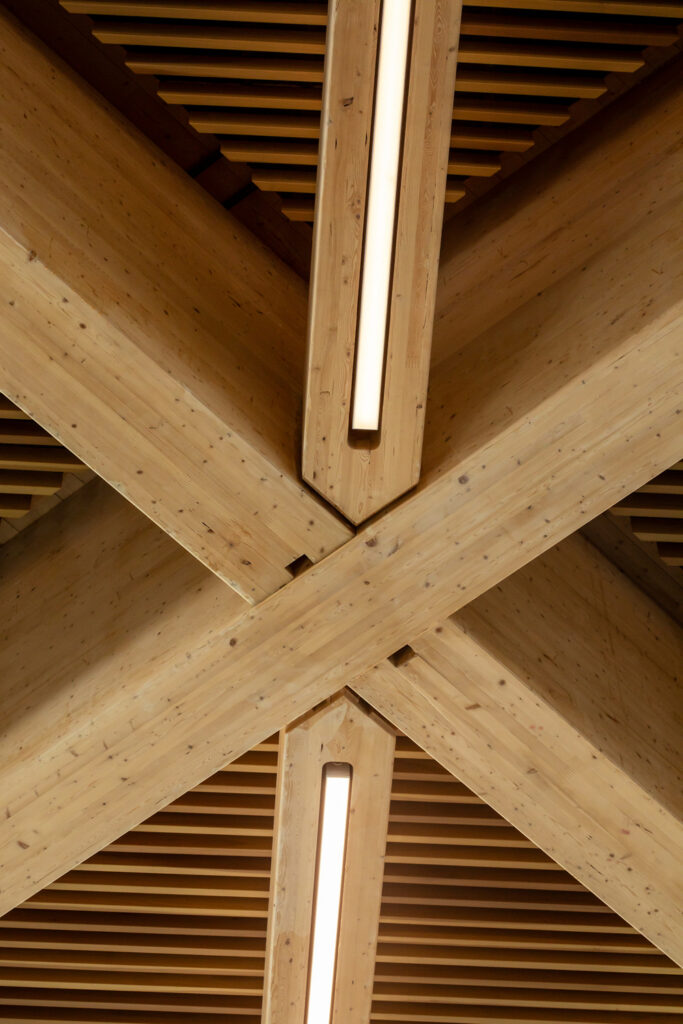
In the lobby, a timber diagrid roof spans the two-story volume, concentrating structural expression at the building’s most public space. “That’s where you really feel the impact of exposed mass timber,” Knittel explains, describing the diagrid as a deliberate moment of structural clarity and civic presence. That same clarity carries through the rest of the building, where the mass timber structure allows mechanical systems to stay out of the ceiling plane—routed instead through the floor and coordinated within suspended acoustic trays carrying chilled beams, electrical, and data. This approach reduces concealed systems while improving access for maintenance and future upgrades.
Instead of hiding industrial function, the building makes infrastructure legible and dignified—a public utility that performs as civic architecture. “Exposed mass timber contributes to that openness, allowing the building’s structure to become part of the public narrative,” Knittel says. Wastewater treatment is reframed as something public-facing, educational, and welcoming: The administrative building doubles as an immersive exhibit space, with public tour touchpoints explaining mass timber, sustainability, and water treatment processes. In Southern California—where water scarcity and drought make conservation an ongoing public concern—this level of visibility goes beyond optics, linking the agency’s work more directly to the communities it serves.
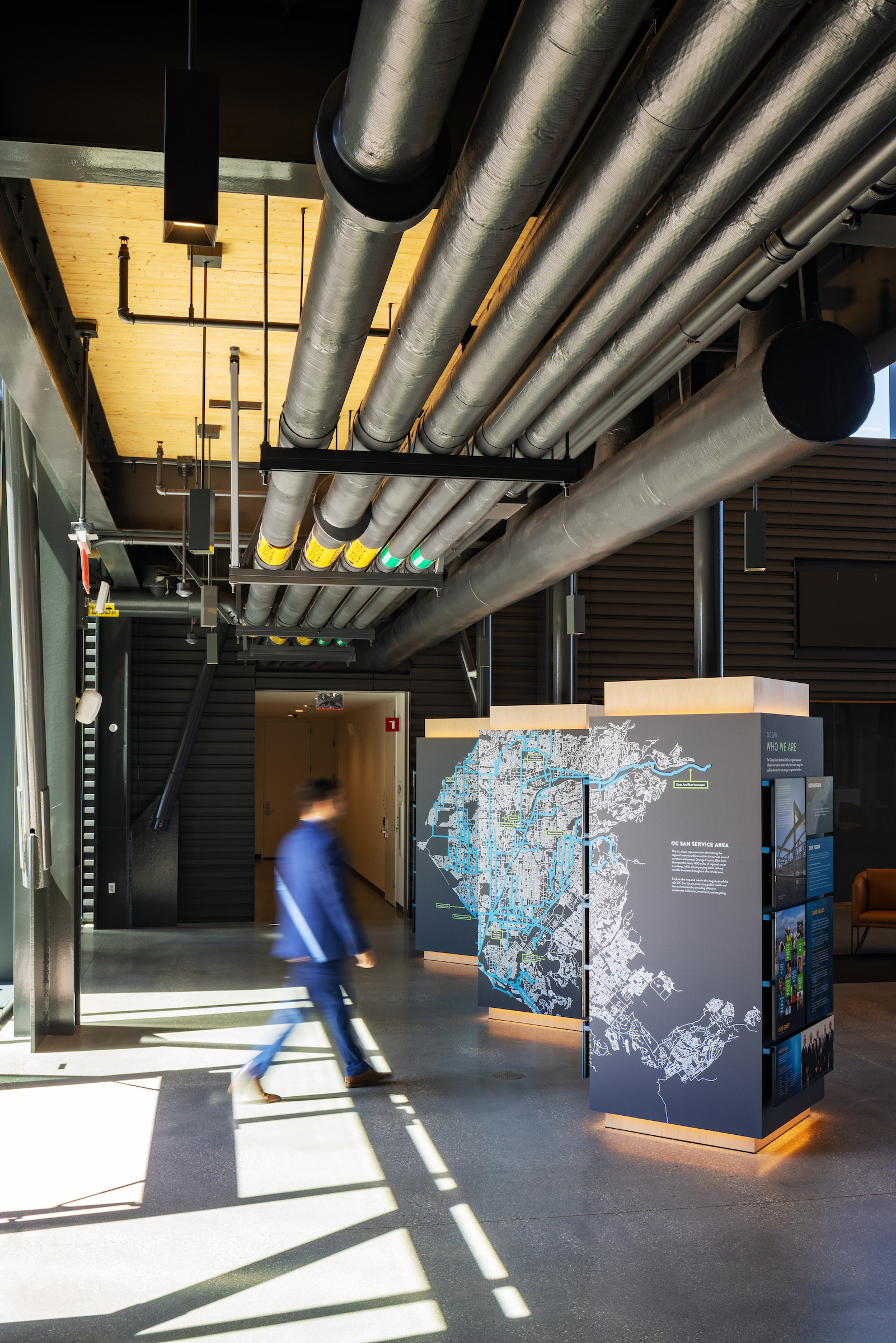
Orange County Sanitation District Headquarters
There’s an overall sense of transparency to the building and its structure, which the design team sees as an extension of the building’s expression as a public space in service to its community. “The first day I walked into the lobby, it was mesmerizing—pictures do no justice,” Chilingaryan says. “And transparency is literal here. The structure is visible, but not decorative. It communicates honesty—what you see is what is working.”
The building is also fostering a positive shift in workplace culture and offering a biophilic boost for employees. Administrative staff once spread across temporary trailers are now consolidated under one roof in a light-filled environment framed by expansive exposed wood—with 98% of occupied spaces deliberately oriented to capture daylight and views of nature. “There’s a warmth to wood you just don’t get with steel or concrete,” Diamond says. “It brings a human scale to a workplace that for some employees was once pretty isolating and fragmented.”
Along with its biophilic benefits and civic expression, the abundant use of mass timber helps the Orange County Sanitation District meet its mandate when it comes to sustainability. Compared with a conventional steel structure, the timber system reduced embodied carbon by an estimated 58%, while its high strength-to-weight ratio minimized foundation requirements and overall material use. The building achieved a LEED-Gold rating and is designed to achieve net-zero operational energy—no small feat—using a combination of on-site photovoltaics, biogas captured from wastewater processes, and waste heat recovery.
Orange County Sanitation District Headquarters
Orange County Sanitation District Headquarters
Mass Timber’s Mass Appeal: Setting a New Benchmark for Public Infrastructure
The project’s ambitions are already resonating beyond the campus. “A neighbor drove by on her way to work and called the district to say, ‘This is such a beautiful building. I’m so proud to have it here,’” Diamond says. “This is not just a beautiful building with wood and glass. It is a game changer for the way they will operate, collaborate, and innovate.”
With generous floor heights, flexible planning, and a hybrid timber structure designed for long-term adaptability, the building shows that mass timber can be a natural fit for infrastructure buildings that must evolve with changing operational needs. Interest in the material is also accelerating. As Diamond noted, “Not long ago mass timber felt niche. Now contractors and clients want to be part of it.” Although the project had to be a hard bid, contractors didn’t shy away from mass timber, and many expressed specific interest in it because it was a mass timber project, she added. “It’s becoming part of the mainstream conversation for projects like this.”
It’s a shift HDR is seeing more broadly, particularly in regions where contractors are seeking out innovative projects that set them apart. As mass timber–friendly building codes expand and production extends across the country, mass timber is becoming a more common material for both public and private sector projects. And builders such as Swinerton, the contractor on this project, are making mass timber a core part of their business.
Orange County Sanitation District Headquarters
Orange County Sanitation District Headquarters
Orange County Sanitation District Headquarters
Project Details
- Project Name:
- Orange County Sanitation District Headquarters (OC San HQ)
- Location:
- Fountain Valley, CA
- Architect:
- Structural Engineer:
- Contractor:
- Mass Timber Supplier / Fabricator:
- Timber Products:
- Size:
- 100,000 square feet
- Photographer:
- Dan Schwalm